Showing posts with label the breeder gallery. Show all posts
Thursday, October 27, 2011
Tuesday, October 26, 2010
Tuesday, October 19, 2010
Thursday, October 7, 2010
Friday, October 1, 2010
Τroō Food Healing Menu
Amuse Bouche
Shot of Blue green Algae with Orange juice, Mint, and Vanilla.
(served cold)
Dehydrated Flax Crackers, Marinated Dehydrated Veggie Chips, Fresh Cut Veggies To Accompany Raw Zucchini Hummus.
Two kinds of Nori Rolls: Ginger - Almond and Thai Sunflower seed rolls with Raw Soy Sauce Dip.
Palette Cleanser
Apple Tonic
Main Course
Superfood Salad with Roasted Pine nuts, Goji Berries, Fresh Figs, Sprouts and a Spirulina - Lemon Sauce with a Hint Of Garlic.
And
Shitake Mushroom Soup with Raw Coconut Oil, Cashew Nut Cream Garnished with Rosemary. Served with a Homemade Fresh Bread Roll. (Served Hot)
Or
Live Raw Pizza Made with Flax Seeds with Super-Herb Marinara Sauce, Black Olives, Wilted Spinach and Sun-Dried Tomatoes
Desserts
Pecan Chocolate Tart
With a side of
Lemon Zest Coconut Mousse
Herbal Teas (on request)
Fresh Luisa or Mint
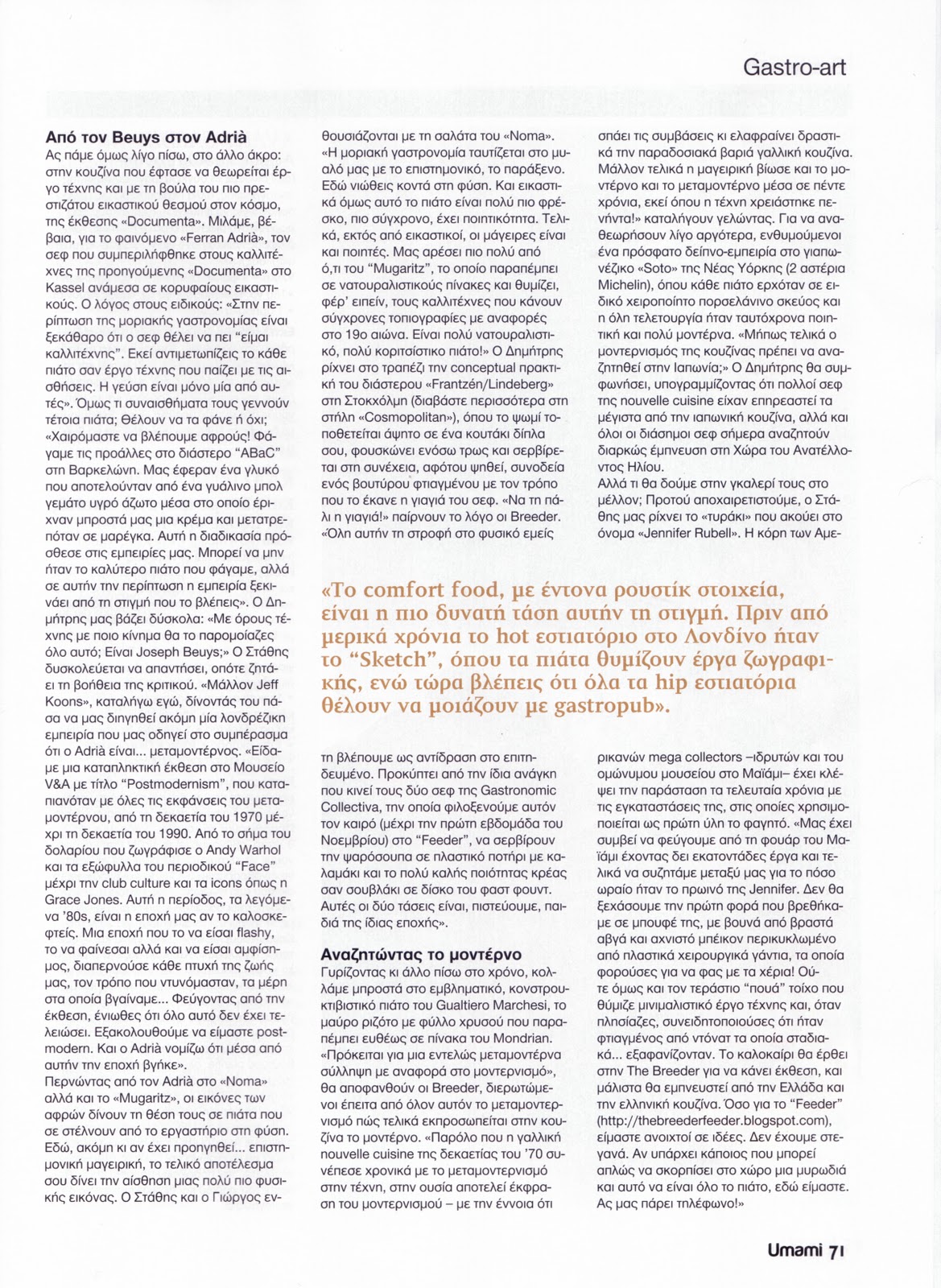
THE FEEDER INVITATION
We are pleased to announce the inauguration of a new project for food and senses,
THE BREEDER FEEDER
THE BREEDER FEEDER is opening on October 5th 2010, on the gallery's second floor, in a space especially designed by architect Andreas Angelidakis. This new concept will be the platform to introduce chefs and teams who have new creative ideas about dining.
The collective TROO FOOD LIBERATION, our first guests, will be hosted for the first three months from October to December and they will present three different vegan-raw menus (chapters), one for every consecutive month.
October, Chapter 1: Healing
"Healing through feeding: we have created a menu of tasteful, healthy and nourishing dishes, that aim to make the most of the beneficiary qualities of the different ingredients through their combinations.
We buy our material from local biological farmers and anything that we cannot source in Greece we buy through fare trade. Our open plan kitchen, the ingredients that will grow inside the space and the constant presence of the creators of the meals, who will always be available to answer any questions that you might have, will all contribute to the whole experience of dinning in THE BREEDER FEEDER. Our aim is to offer you the knowledge and the spirit needed for a positive change to happen in our health and the environment that surrounds us".
-TROO FOOD LIBERATION
Next chapters include:
November, Chapter II : Sensuality / Sexuality
December, Chaper III: The Origins of Food
The Healing menu of TROO FOOD LIBERATION will be offered every Tuesday, Thursday, and Friday from 9pm and particularly on the 5, 7, 8, 12, 14, 15, 19, 21, 22, 26, 28 and 29 of October.
TROO FOOD LIBERATION have created a 5 course set menu, priced at 25 euros per person.
Booking for Chapter I have already started. Each booking can be for up to 6 people.
For reservations please contact the gallery at +30 210 3317527 (Tuesday to Saturday 12-6pm) or email feeder@thebreedersystem.com
Thursday, September 30, 2010
THE FEEDER PROJECT (Collage Nation)
The Feeder Project (Collage Nation)
In an engraving dating to 1836, we can see an interesting incident from the Athenian life of that period. The main room of The Beautiful Hellas café is split in two compartments: on the left side, customers are dressed in European way, drinking beer and smoking cigars while a billiard table is placed in between. On the right part of the room, the rest of the customers are traditionally dressed in fustanellas and colorful woven vests and seem to drink raki, while smoking the traditional chibouk. At the center of the image, a man wearing a redingote, the trademark of Europeanized “Alafranga” Greeks, talks with a man who wears a fustanella and the traditional cloak, a thick woolen shepherd’s coat.
In this simple way, Bavarian artist Kollnberger illustrates not only a scene of everyday life, but also the wider dichotomy of society during the instauration of the Modern Greek state. It was the time that would eventually lead the country to the bankruptcy of 1896, under the governance of Charilaos Trikoupis and the enforcement of inspectional measures prescribed by the International Economic Committee.
Back then, and even today possibly, Greece was the outcome of a peculiar collage. On the one hand were the Alafranga, the Greeks coming from Europe who attempted to establish the new state as the ideal continuation of ancient Greece; therefore they imported neoclassicism, the European way of dressing, as well as the royal family. The Alafranga envisioned Greece as a European country, where people should dress modernly, speak formal Greek and admire the romantic charm of the white marble ruins of Acropolis. The actual Greece had just been detached from the Ottoman Empire and hence still kept many elements from the East. The warriors still wore the traditional fustanella and were hidden in the mountains, covered with lambskins and colorful thick knitwear. They also wanted to be part of the country being shaped right then. They would built their homes with any available material and make their sheepfolds from branches and pieces from ruined houses. Even churches were built from the debris of ancient temples. All these would result in a continuous collage, an early method of recycling buildings. We could say that they constructed their own ruins. Even nowadays, in the Greek province but also in cities, it’s common for the houses to evolve within time through additions and extensions, in order to accommodate the whole family. Even today, Greece is a collage of its glorious and somewhat iconic ancient past and the living “real” present.
The space of the Feeder Project is the synthesis of two distinct proposals for the furnishing of a restaurant.
The first restaurant is designed as a series of ergonomically dimensioned white elements that refer to the methodologically organized marble pieces of an ancient structure. The other consists of vintage furniture from the 70’s and the 80’s, a bit rustic and in a way traditional, that was found in flea markets around the area of Metaxourgio.
In their coexistence, these two restaurants are tangled, bound, cut and glued back together. An old table is cut in four halves and its pieces are placed between the white furnishing, supporting tables and completing sitting areas. The wooden rustic chairs are split in the middle and placed on white footstalls, as if they were exhibits. All the leftovers are re-used in a continuous collage of two systems, of the ideal white system and the random meeting of old furniture. Joined with visible brand-new metallic elements, these objects eventually see their functionality being transformed: chairs turned into benches, tables extending to columns, new seats emerging from the composition of older ones, traditional colorful textiles spread on the white sleek surfaces, in an architecture that consists of what we are thinking and of what we have found before us, in a snapshot of amalgamation between the iconic and the real.
Andreas Angelidakis
Subscribe to:
Posts (Atom)